
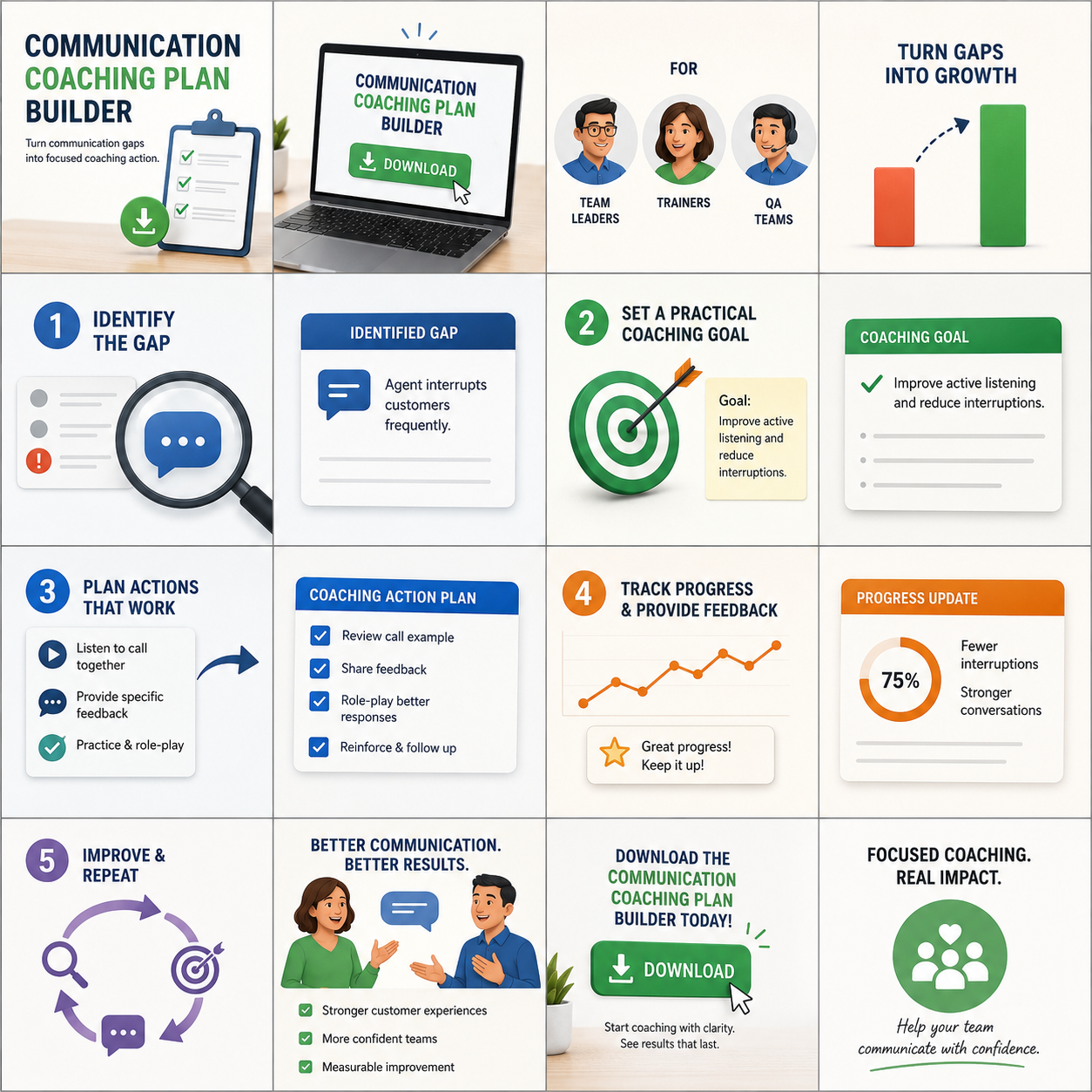
A practical template for turning communication gaps into focused coaching action.
Communication coaching often fails because the goal is too vague.
An agent is told to be clearer, show more empathy, improve written communication, or ask better questions. Those may be valid goals, but they are not yet a coaching plan. They do not tell the agent what to practice, what better looks like, or how progress will be reviewed.
A stronger coaching plan connects four things:
What communication gap was observed
Why it matters in the role
What the agent will practice
How improvement will be checked
This template is designed to help team leaders, trainers, QA teams, and coaches move from general feedback to practical action.
How to Use This Builder
Use this tool after an assessment, QA review, nesting observation, mock interaction, customer transcript, or coaching conversation.
You do not need to complete every section perfectly. The goal is to make the next coaching step clear enough that both the coach and the agent know what to work on.
For each agent, choose one or two focus areas at a time. Trying to fix everything at once usually creates confusion. Coaching works better when the focus is specific.
Step 1: Identify the Communication Focus Area
Choose the main area that needs development.
Focus area:
Clarity
Structure
Listening and summarizing
Empathy that reduces effort
Clarifying questions
Written communication
Next-step explanation
Tone and professionalism
Confidence under pressure
Other: ___________________________
Observed issue:
Write what was actually observed. Avoid vague labels.
Instead of writing:
“Needs better communication.”
Write:
“Agent apologized to the customer but did not explain what would happen next.”
Or:
“Agent gave a long explanation, but the customer still did not understand the process.”
Or:
“Written update was polite but did not include a clear status or timeline.”
Observed issue:
Step 2: Connect the Gap to the Role
Communication coaching is stronger when the agent understands why the skill matters.
Why this matters in the role:
Customers may repeat themselves if the issue is not summarized clearly.
Customers may lose confidence if the next step is unclear.
Long explanations can increase handle time and confusion.
Vague written updates can create repeat contacts.
Poor clarifying questions can lead to wrong assumptions.
Empty empathy can sound scripted and fail to reduce frustration.
Other: ___________________________
Role impact statement:
Complete this sentence:
“When this communication gap shows up in the role, it can lead to…”
Step 3: Set a Specific Coaching Goal
A good coaching goal should be simple, observable, and connected to the work.
Instead of:
“Improve empathy.”
Use:
“Respond to frustrated customers by recognizing the customer burden and explaining the next useful action.”
Instead of:
“Improve clarity.”
Use:
“Summarize the customer issue in one or two sentences before explaining the next step.”
Instead of:
“Improve writing.”
Use:
“Write customer updates that include status, next step, and timeline when available.”
Coaching goal:
Step 4: Choose the Practice Activity
Choose one activity that matches the coaching goal.
If the focus is listening, clarity, or issue confirmation
Use: The Explain-It-Back Drill
The agent practices summarizing the customer issue in one or two clear sentences.
Practice prompt:
“Summarize what the customer needs help with before moving to the solution.”
If the focus is empathy, repeat contacts, or complaints
Use: Empathy That Reduces Effort
The agent practices recognizing the customer burden and taking an action that reduces effort.
Practice prompt:
“Show the customer you understand what this has cost them, then explain how you will avoid making them start over.”
If the focus is process explanation
Use: The One-Minute Process Explanation
The agent practices explaining a common process using simple steps.
Practice prompt:
“Explain this process using: first, next, then.”
If the focus is written communication
Use: Rewrite the Customer Update
The agent rewrites a vague message into a clearer customer update.
Practice prompt:
“Add the status, next step, and timeline where possible.”
If the focus is problem-solving or missing information
Use: Clarifying Question Practice
The agent practices asking the first three questions needed to understand the issue.
Practice prompt:
“What do you need to know before you can help?”
Selected activity:
Practice prompt to use:
Step 5: Define What Good Looks Like
Before coaching begins, define what improvement should look like.
This helps the agent understand the target.
A stronger response should include:
Clear summary of the issue
Simple explanation
Specific next step
Useful clarifying questions
Recognition of customer effort or burden
Clear written status
Professional tone
Timeline or expectation where available
Other: ___________________________
What good looks like for this agent:
Step 6: Practice and Capture Notes
Use this section during the coaching session.
Scenario or interaction used:
Agent’s first attempt:
Coach feedback:
Agent’s improved attempt:
Step 7: Set the Follow-Up
Coaching should not end with the session. Set a follow-up point to check whether the skill is improving in real work.
Follow-up date:
Evidence to review:
QA interaction
Live call observation
Chat transcript
Email or ticket sample
Mock scenario
Nesting observation
Customer feedback
Other: ___________________________
What we will look for next time:
30-Day Coaching Plan
Use this simple rhythm for one agent or a small coaching group.
Week 1: Diagnose and Focus
Identify the main communication gap. Choose one focus area and one practice activity.
Focus area:
Activity:
Week 2: Practice and Feedback
Run the selected activity. Give feedback on one or two specific behaviours.
What improved:
What still needs work:
Week 3: Apply to Real Work
Review one real interaction or realistic scenario. Look for the same communication skill in action.
Evidence reviewed:
Observation:
Week 4: Review and Decide Next Step
Decide whether to continue, move to a new focus area, or escalate for additional support.
Decision:
Continue same focus
Move to new focus area
Assign additional practice
Escalate for trainer or manager support
Other: ___________________________
Next step:
Coaching Plan Summary
Use this summary to keep the plan simple and visible.
Agent name: ___________________________________________
Role / queue / channel: _________________________________
Coach: ________________________________________________
Date created: __________________________________________
Primary communication focus: ____________________________
Observed issue: ________________________________________
Coaching goal: _________________________________________
Selected activity: ______________________________________
Follow-up date: ________________________________________
Success measure: _______________________________________
Key Takeaways
Coaching works better when it is specific.
A vague goal like “be clearer” is hard to act on. A specific goal gives the agent something to practice.
Focus on one or two skills at a time.
Trying to fix everything at once usually leads to shallow coaching and limited improvement.
The coaching activity should match the gap.
If the issue is written clarity, use a writing activity. If the issue is customer frustration, practice empathy that reduces effort.
Define what good looks like before coaching begins.
Agents need to know what a stronger response sounds like, not just what was wrong.
Follow-up is part of the plan.
A coaching session is only useful if improvement is checked in real or realistic work.
Evala helps make coaching more targeted.
When teams understand the specific communication areas that need support, coaching becomes more focused, fair, and practical.