
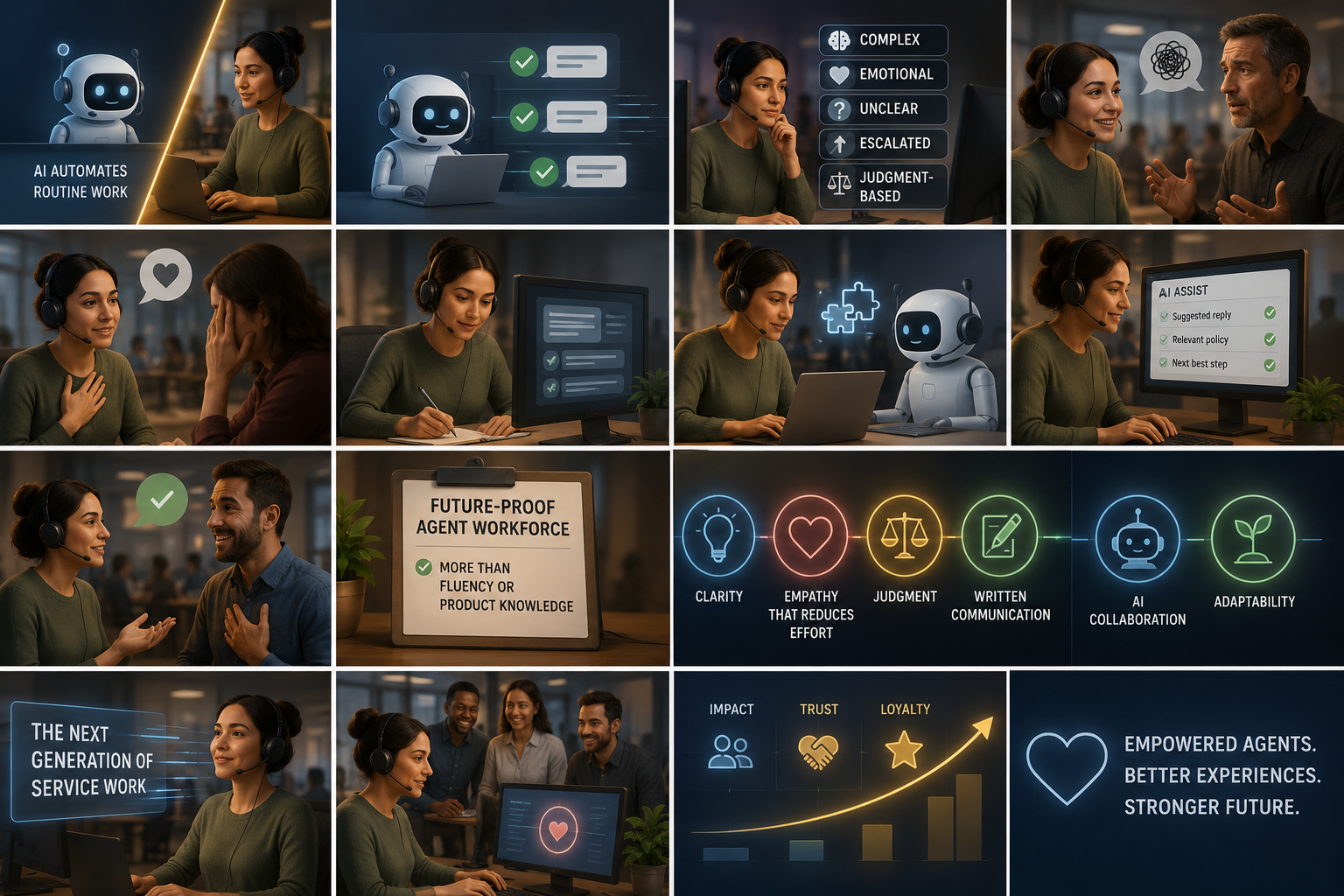
AI is changing customer service faster than most operating models are prepared for.
For years, contact centers and BPOs have been built around volume. More contacts, more agents, more queues, more workflows, more training classes, more productivity pressure. The model was never perfect, but it was familiar. You could forecast demand, hire people, train them, measure handle time, monitor QA, and keep the system moving.
AI is starting to disrupt that logic. The simple contacts are becoming easier to automate. Basic status checks, password resets, order updates, policy questions, routine troubleshooting, scripted responses, and repeatable workflows are increasingly moving toward self-service, bots, copilots, automation, and agentic AI. That does not mean the agent role disappears overnight. It does mean the role changes.
The work left for humans will often be the work that is harder to automate. It will be more emotional, more complex, more ambiguous, more sensitive, and more dependent on judgment. That is the shift leaders need to prepare for now.
The Easy Work Is Leaving the Queue
For a long time, customer operations could use simpler contacts as the place where new agents learned the job. A new hire could start with basic questions, predictable issues, and lower-risk interactions. Over time, they could build confidence, learn the systems, understand the customer base, and grow into more complex work.
AI changes that pathway. If automation removes more of the easy work, then human agents may enter a very different environment. They may be asked to handle difficult interactions earlier. They may receive fewer simple contacts to build confidence. They may spend more time with customers who already tried self-service and failed. They may be dealing with customers who are more frustrated by the time they reach a person. That creates a real workforce readiness problem.
If the remaining work is harder, then the communication standard has to rise.Not because every agent needs perfect English. Not because everyone needs to sound the same. Not because humans are competing with AI by acting more robotic.
The standard rises because the human moments will matter more.
The Human Work Will Be More Exposed
When a customer reaches a human agent after an automated journey, that conversation carries more weight.
The customer may have already searched the help center. They may have tried a bot. They may have repeated information. They may have waited. They may be coming into the interaction with less patience and less trust. At that point, the human agent is not just answering a question. They are repairing confidence. That requires more than friendliness. It requires clear thinking, useful language, emotional control, and the ability to move the customer forward without making the experience heavier.
This is where many current coaching models are not ready. Telling agents to “show empathy” is not enough. Asking them to “be clearer” is not enough. Giving them a script for every situation is not enough. Future-ready service work will require agents who can understand what is really happening, make sense of messy information, reduce customer effort, and communicate the next step with confidence. The more AI handles the routine work, the more visible human communication becomes.
Future-Ready Agents Need More Than Fluency
English proficiency still matters in many global service roles. It matters because agents need to understand customers, systems, documentation, policies, and internal instructions.
But fluency is not the same as readiness. A fluent agent may still struggle to calm a customer. A candidate with strong vocabulary may still write confusing updates. Someone who sounds confident in an interview may still avoid clarifying questions when the issue is unclear. Someone with a high language score may still fail to explain what happens next.
The future agent needs a wider set of communication skills. They need to be clear under pressure. They need to show empathy that reduces effort. They need judgment and sense-making. They need written clarity. They need to work with AI without blindly trusting it. They need adaptability because the tools, workflows, and customer expectations will keep changing.
That is the real future-proofing work. Not just adding AI tools, teaching people how to prompt a system, or just reducing headcount and hoping the remaining agents can handle the complexity. Future-proofing means preparing humans for the kind of work that will still need humans.
Six Communication Skills That Matter More Now
The future agent will not be defined only by product knowledge or speed. Those things still matter, but they are not enough. The next version of frontline service work will require a deeper communication profile.
1. Clarity Under Pressure
Customers do not always arrive calm, organized, or easy to understand. They may be upset, confused, anxious, or tired of repeating themselves.
A future-ready agent can still explain clearly in those moments. They can summarize the issue, remove unnecessary complexity, and tell the customer what happens next.
Clarity under pressure is not about sounding polished. It is about being useful when the situation is messy.
2. Empathy That Reduces Effort
Empathy in service work is often misunderstood.
It is not only saying, “I’m sorry.” It is not only naming the customer’s frustration. Those things can help, but they are not enough by themselves. Real empathy reduces the customer’s burden.
It sounds more like:
“Let’s not waste any more of your time. I’ll check the previous notes first so I can get the story straight, and then I’ll tell you clearly what I can do next.”
That kind of response shows the agent understands what the experience has cost the customer. It also changes the way the interaction is handled. In the AI era, this matters even more. If the customer has already gone through a bot or self-service path, the human agent cannot afford to make the customer feel like they are starting over again.
3. Judgment and Sense-Making
AI can surface information, suggest responses, summarize notes, and recommend next steps. That does not remove the need for human judgment.
In fact, it may increase it. Agents will need to decide whether the AI suggestion fits the situation. They will need to notice when the customer’s real concern is different from the stated issue. They will need to ask better questions when the situation is unclear. They will need to know when to escalate, when to slow down, and when to take ownership.
Sense-making is the ability to interpret what is happening, not just follow what is written. That will become one of the most important human skills in service operations.
4. Written Communication
Service work is becoming more digital, and digital work leaves a trail.
Chats, emails, case notes, ticket updates, internal handoffs, social responses, summaries, and AI-assisted messages all depend on writing. A message can be polite and still be useless. It can be grammatically acceptable and still fail to tell the customer what they need to know.
Future-ready agents need to write with clarity, structure, and purpose. A useful customer update should usually include the status, the next step, and the timeline where available. A useful internal note should help the next person act without rework. A useful AI-assisted message should be reviewed before it reaches the customer.
Writing will not be a side skill. It will be a core operating skill.
5. AI Collaboration Readiness
The future agent will not only communicate with customers. They will also communicate with, through, and around AI systems.
They may receive AI-suggested replies. They may review summaries. They may use copilots to search policies, draft responses, or recommend actions. They may need to correct the AI when it misses context, sounds too generic, or gives a response that does not fit the customer’s situation.
That requires a new kind of readiness. Agents need to understand that AI output is not the same as customer-ready communication. They need to review it, improve it, and take ownership of the final message. AI can support the agent, but it should not replace the agent’s judgment.
6. Adaptability and Learning Agility
The tools will keep changing. The workflows will keep changing. The customer journey will keep changing.
That means future-ready agents need to learn, adjust, and recover quickly. They need to take coaching and apply it. They need to handle work that does not follow the standard script. They need to stay curious enough to improve their communication skills as the role evolves.
Adaptability is not a soft extra. It is the skill that keeps people relevant when the operating model changes around them.
What Leaders Should Do Now
Future-proofing the agent workforce cannot be left to a future training class. It needs to start now.
Leaders should begin by looking honestly at the communication demands of the work. Which contacts are becoming automated? Which contacts are staying with humans? What kind of communication do those remaining contacts require? Are agents prepared for that level of complexity?
Then leaders need to assess the workforce against the skills that will matter next.
Not only English level.
Not only QA score.
Not only average handle time.
Not only training completion.
Those measures may still matter, but they do not fully answer the future-readiness question.
The better questions are:
Can agents explain clearly when customers are frustrated?
Can they reduce effort instead of adding to it?
Can they make sense of unclear situations?
Can they write useful updates?
Can they review and improve AI-supported messages?
Can they adapt as the work changes?
Once leaders know the answer, they can make better decisions about hiring, coaching, placement, and development.
Placement Will Matter More
Future readiness is not only about training everyone the same way.
Some agents may be ready for complex voice interactions. Others may be better placed in chat, email, case management, back-office support, or structured digital workflows while they build confidence. Some may be strong at calming difficult customers but need help with written documentation. Others may be accurate and process-driven but not ready for high-emotion conversations.
The goal is not to label people permanently. The goal is to place people intelligently and develop the next skill.
As the work becomes more complex, poor placement will become more expensive. The wrong person in the wrong seat can create customer frustration, QA risk, supervisor rescue, and agent burnout. The right person in the right seat can ramp faster, perform better, and grow into more complex work over time.
Where Evala Fits
Evala helps leaders move beyond generic language testing and understand workplace communication readiness more directly.
That matters because the future of service work will not be solved by fluency alone. Organizations will need to know whether candidates and agents can communicate clearly, reduce customer effort, use judgment, write effectively, collaborate with AI, and adapt to changing work.
Evala gives hiring, training, and operations teams a better way to see those signals. That helps leaders hire better, coach better, place better, and prepare the workforce for what comes next. The future of customer service is not just AI replacing tasks. It is humans being asked to handle the moments where communication matters most.
That is why future-proofing the agent workforce starts with communication readiness.
Key Takeaways
AI is changing the shape of frontline service work.
As routine contacts become automated, human agents will increasingly handle more complex, emotional, unclear, and judgment-based interactions.
The human work that remains will require stronger communication.
Future-ready agents need clarity under pressure, empathy that reduces effort, judgment, written communication, AI collaboration readiness, and adaptability.
Fluency alone is not enough.
English proficiency matters, but it does not prove that an agent can manage a difficult conversation, write a useful update, or make sense of an unclear customer issue.
AI collaboration requires human ownership.
Agents need to review, adjust, and improve AI-generated suggestions before they become customer communication.
Placement becomes part of future-proofing.
Leaders need to understand where people are ready now, where they need support, and which communication environment gives them the best chance to succeed.
Evala helps make future readiness measurable.
By assessing practical workplace communication, Evala helps organizations prepare people for the service work that will still need humans.