
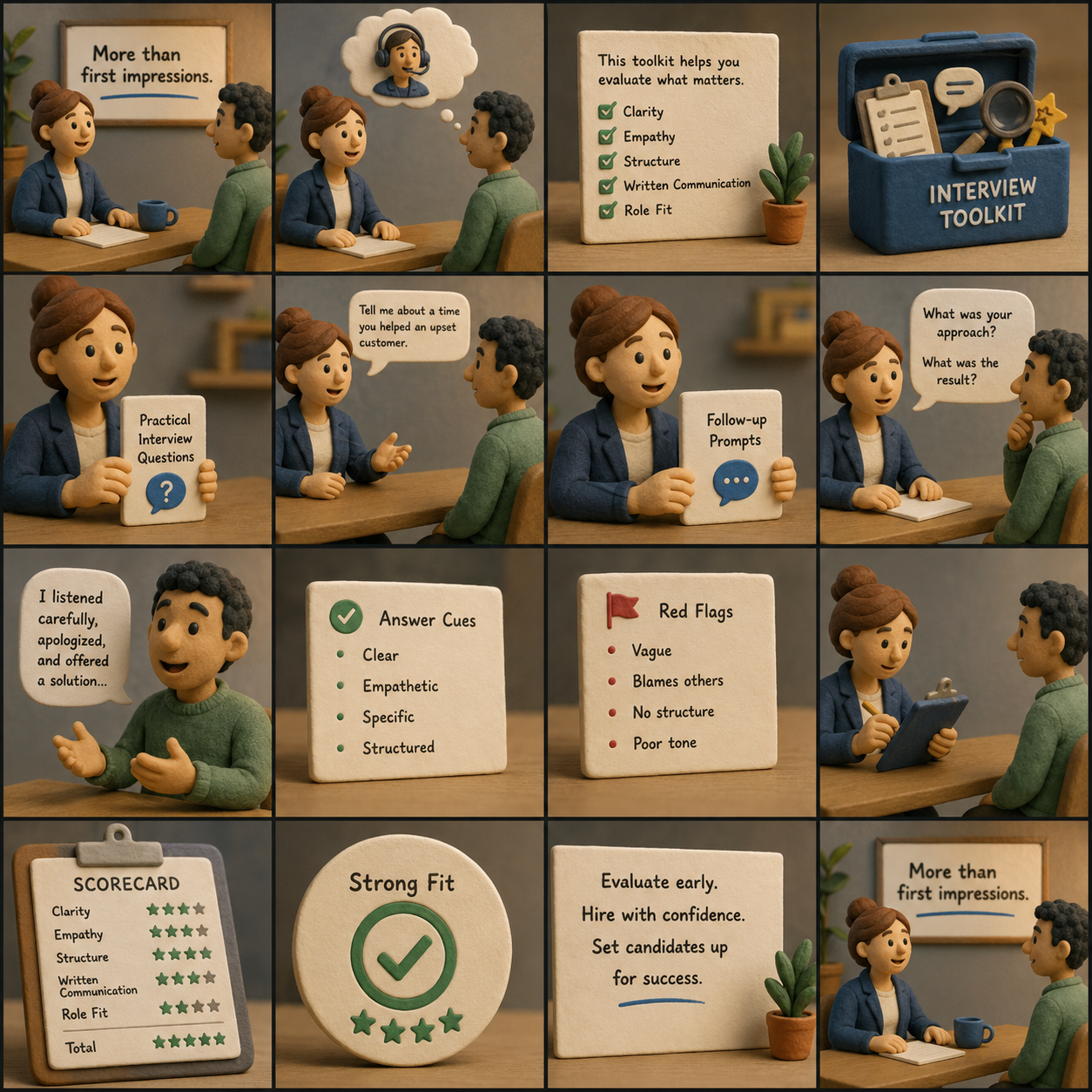
A practical question bank for spotting whether a candidate is ready for customer-facing communication.
Recruiters are often expected to make quick decisions from short conversations. That is not easy, especially when a candidate sounds confident, friendly, and fluent enough to pass the first impression test.
But communication readiness is not only about sounding good in an interview.
It is about whether the candidate can understand a situation, explain clearly, respond to pressure, show empathy, ask useful questions, and give the customer a clear next step.
This toolkit is designed to help recruiters ask better questions and listen for better evidence.
It is not meant to make interviews longer or more complicated. It is meant to help you get more value from the time you already have.
How to Use This Toolkit
Use these questions during recruiter screening, final interviews, assessment days, or calibration sessions with hiring teams.
You do not need to ask every question. Choose the ones that match the role.
For voice roles, focus more on verbal clarity, empathy, and explanation.
For chat, email, ticketing, or back-office roles, always include a short writing task.
For complex support roles, include questions that test problem-solving and follow-up.
As you listen, pay attention to three things:
Did the candidate answer the question clearly?
Did they give enough detail to be useful?
Did they move the conversation toward a clear next step?
Those three signals will tell you a lot.
Quick Recruiter Scoring Guide
Use this simple scale while listening to candidate answers.
Strong readiness: The candidate gives a clear, specific, organized answer and shows how they would communicate with the customer or teammate.
Some readiness: The candidate gives a generally useful answer, but may need prompting, coaching, or more structure.
Low readiness: The candidate stays vague, avoids the question, struggles to explain, or gives an answer that would confuse or frustrate a customer.
This is not about perfect grammar. It is about whether the communication would work in the role.
Question 1: The Real Example Question
Ask the candidate:
“Tell me about a time you helped someone solve a problem. What happened, what did you do, and what was the result?”
What this question tests
This tests whether the candidate can give a real example instead of only describing themselves in positive words. It also shows whether they can organize a situation clearly.
What a stronger answer sounds like
A stronger answer explains the problem, what the candidate personally did, how they communicated, and what happened after that.
The candidate may say something like:
“A customer could not understand why their payment had not posted yet. I checked the account, explained the pending period in simple terms, and told them when they should expect the update. I also explained what they could do if the payment did not show by that date.”
That kind of answer shows structure, ownership, and customer awareness.
What a weaker answer sounds like
A weaker answer may sound positive but stay vague.
“I always help customers because I am patient and I like solving problems.”
That may be true, but it does not show what the candidate actually did.
Follow-up probe
“Can you give me one specific example?”
Use this when the first answer is too general. A candidate who is communication-ready should usually be able to add detail after one prompt.
Question 2: The Frustrated Customer Question
Ask the candidate:
“A customer says, ‘I already contacted you three times and nobody has helped me.’ What would you say?”
What this question tests
This tests whether the candidate can combine empathy with action. In customer service, saying “I’m sorry” is not enough if the customer still does not know what happens next.
What a stronger answer sounds like
A stronger answer acknowledges the frustration, avoids blaming other people, and explains what the candidate would do next.
The candidate may say something like:
“I’m sorry you’ve had to contact us several times. I understand why that would be frustrating. Let me check the previous notes so I do not make you repeat everything again, and then I’ll explain what I can do next.”
That answer works because it is calm, respectful, and useful.
What a weaker answer sounds like
A weaker answer may be polite but incomplete.
“I would apologize and tell them we are doing our best.”
That answer does not create confidence. It does not explain what happens next.
Follow-up probe
“What would you say after the apology?”
This helps you see whether the candidate can move beyond empathy into action.
Question 3: The Explain-It-Simply Question
Ask the candidate:
“Explain a process you know well, as if you were teaching it to a new teammate.”
What this question tests
This tests whether the candidate can organize information. Many customer roles require agents to explain steps, timelines, policies, troubleshooting instructions, or account updates.
What a stronger answer sounds like
A stronger answer is simple and ordered.
The candidate may say something like:
“First, I would show the teammate where to find the information. Then I would explain each step and why it matters. After that, I would let them try it while I observe, and I would correct anything unclear.”
That answer shows sequence and coaching awareness.
What a weaker answer sounds like
A weaker answer may jump around, include too much detail, or assume the listener already understands.
“When I train someone, I just tell them everything they need to know and make sure they understand.”
That does not show how the candidate explains information.
Follow-up probe
“How would you explain that more simply?”
This is useful when the first explanation is too long or unclear.
Question 4: The Missing Information Question
Ask the candidate:
“A customer says, ‘My order is wrong,’ but they do not give any details. What questions would you ask first?”
What this question tests
This tests whether the candidate can ask clarifying questions instead of guessing. Good customer communication often depends on getting the right information early.
What a stronger answer sounds like
A stronger answer asks for the information needed to understand and resolve the issue.
The candidate may say something like:
“I would ask for the order number, what item they expected, what they received, and whether there were any photos or confirmation emails. Then I would check the order details before explaining the next step.”
That answer shows clear thinking and process.
What a weaker answer sounds like
A weaker answer may jump too quickly into apology or resolution.
“I would apologize and tell them we will fix it.”
That sounds helpful, but the candidate does not yet have enough information to know what needs to be fixed.
Follow-up probe
“What information would you need before you could help them?”
This helps test whether the candidate can slow down and gather facts.
Question 5: The Next Step Question
Ask the candidate:
“A customer has a problem you cannot solve immediately. How would you explain the next step?”
What this question tests
This tests whether the candidate can manage expectations. Customers often become more frustrated when they do not know what is happening, even if the issue is being worked on.
What a stronger answer sounds like
A stronger answer is honest, clear, and specific.
The candidate may say something like:
“I would explain that I cannot resolve it immediately, but I am going to escalate it to the right team. I would tell the customer what information I am sending, when they can expect an update, and what they should do if they do not hear back.”
That answer gives direction.
What a weaker answer sounds like
A weaker answer is too general.
“I would tell them to wait and someone will help them.”
That may leave the customer uncertain or more frustrated.
Follow-up probe
“What timeline or expectation would you give the customer?”
This helps you see whether the candidate understands the importance of expectation-setting.
Question 6: The Written Customer Update
Use this question for chat, email, ticketing, social media, back-office, or any role where written communication matters.
Ask the candidate:
“A customer is waiting for an update, but the issue is still being reviewed. Write a short message that apologizes briefly, explains the current status, and gives a clear next step.”
What this question tests
This tests whether the candidate can write a message that is clear, professional, and useful to the customer.
What a stronger answer sounds like
A stronger written answer may look like this:
“Thank you for your patience. I’m sorry this is taking longer than expected. Your issue is still being reviewed by our support team, and we are checking the details needed to complete the update. We will contact you again by tomorrow with the next update.”
This message is not perfect, but it is clear and useful.
What a weaker answer sounds like
A weaker written answer may look like this:
“Sorry for the inconvenience. We are doing the needful and will update you soon.”
This is polite, but it is not specific enough. The customer does not know what is happening or when to expect another update.
Follow-up probe
“Can you make the message more specific?”
This helps test whether the candidate can improve written clarity after feedback.
Question 7: The De-Escalation Question
Use this for roles involving complaints, escalations, collections, technical support, fraud, billing, or sensitive customer situations.
Ask the candidate:
“A customer is upset and says, ‘You people keep making the same mistake.’ How would you respond?”
What this question tests
This tests whether the candidate can stay calm, avoid defensiveness, and bring the conversation back to resolution.
What a stronger answer sounds like
A stronger answer acknowledges the customer’s emotion without arguing.
The candidate may say something like:
“I understand why it feels that way, especially if this has happened more than once. Let me look at the details so I can understand what went wrong and what we can do to correct it.”
That answer does not blame the customer or the company. It keeps the conversation moving.
What a weaker answer sounds like
A weaker answer may become defensive.
“I would tell them we are not making mistakes and they need to calm down.”
That answer could escalate the situation.
Follow-up probe
“How would you keep the customer calm while still getting the information you need?”
This helps test emotional control and conversation management.
Question 8: The Role Fit Question
Ask the candidate:
“Which type of customer communication do you think you handle best: phone, chat, email, or face-to-face? Why?”
What this question tests
This helps reveal self-awareness and possible role fit. Some candidates may be stronger in written communication. Others may be stronger in live conversation. The goal is not always pass or fail. Sometimes the goal is better placement.
What a stronger answer sounds like
A stronger answer explains the reason behind the preference.
The candidate may say something like:
“I think I am strongest in chat or email because I organize my thoughts better in writing. I can handle phone calls too, but I know I need to keep practicing how to respond quickly.”
That answer shows self-awareness.
What a weaker answer sounds like
A weaker answer may be unrealistic or unsupported.
“I can do everything. I am good at all communication.”
That may be true, but it does not show much reflection.
Follow-up probe
“What type of customer situation would be hardest for you?”
This helps you understand development needs before the candidate reaches the role.
Quick Interview Scorecard
Use this as a simple checklist after the interview.
Communication SignalStrongSome ConcernHigh ConcernAnswers the actual questionGives specific examplesExplains information clearlyOrganizes thoughts in a simple orderShows empathy with actionAsks useful clarifying questionsGives a clear next stepAdjusts after a follow-up questionWrites clearly, if required for the role
Simple Decision Guide
A candidate is likely showing stronger readiness when they can answer clearly, give specific examples, explain information in order, show empathy without becoming robotic, ask clarifying questions, and provide a useful next step.
A candidate may need more review when they sound fluent but stay vague, rely on memorized answers, avoid the question, apologize without action, struggle to explain simple information, or write messages that a customer may not understand.
This decision should not be based on accent. It should not be based on whether the candidate sounds like a native speaker. It should be based on whether their communication is clear enough, useful enough, and role-ready enough for the work.
How This Toolkit Supports Better Hiring
Recruiters are not just screening for availability. They are helping decide whether the candidate is ready for the communication demands of the role.
When communication readiness is missed in hiring, the problem usually appears later in training, nesting, QA, customer complaints, supervisor escalations, and attrition. That is hard on the business, but it is also hard on the candidate.
A better interview process does not need to be longer. It needs to be sharper.
Ask questions that reveal how the candidate thinks, explains, responds, and writes. Listen for evidence, not just confidence. Use follow-up questions when the first answer is too general.
That is how recruiters help make better hiring decisions earlier.
Key Takeaways
Do not screen only for fluency.
Fluency matters, but it does not prove the candidate can handle customer communication.
Ask for examples.
Specific examples reveal much more than general claims about being helpful, patient, or customer-focused.
Listen for empathy plus action.
A good customer response should acknowledge the issue and explain what happens next.
Use follow-up questions.
When an answer is vague, ask the candidate to be more specific or explain it more simply.
Test writing when writing is part of the role.
A short written customer update can reveal risks that a spoken interview may miss.
Use communication readiness to support better fit.
The goal is not only to pass or reject. It is to understand whether the candidate is ready for the role, needs support, or may be better suited to a different communication channel.