
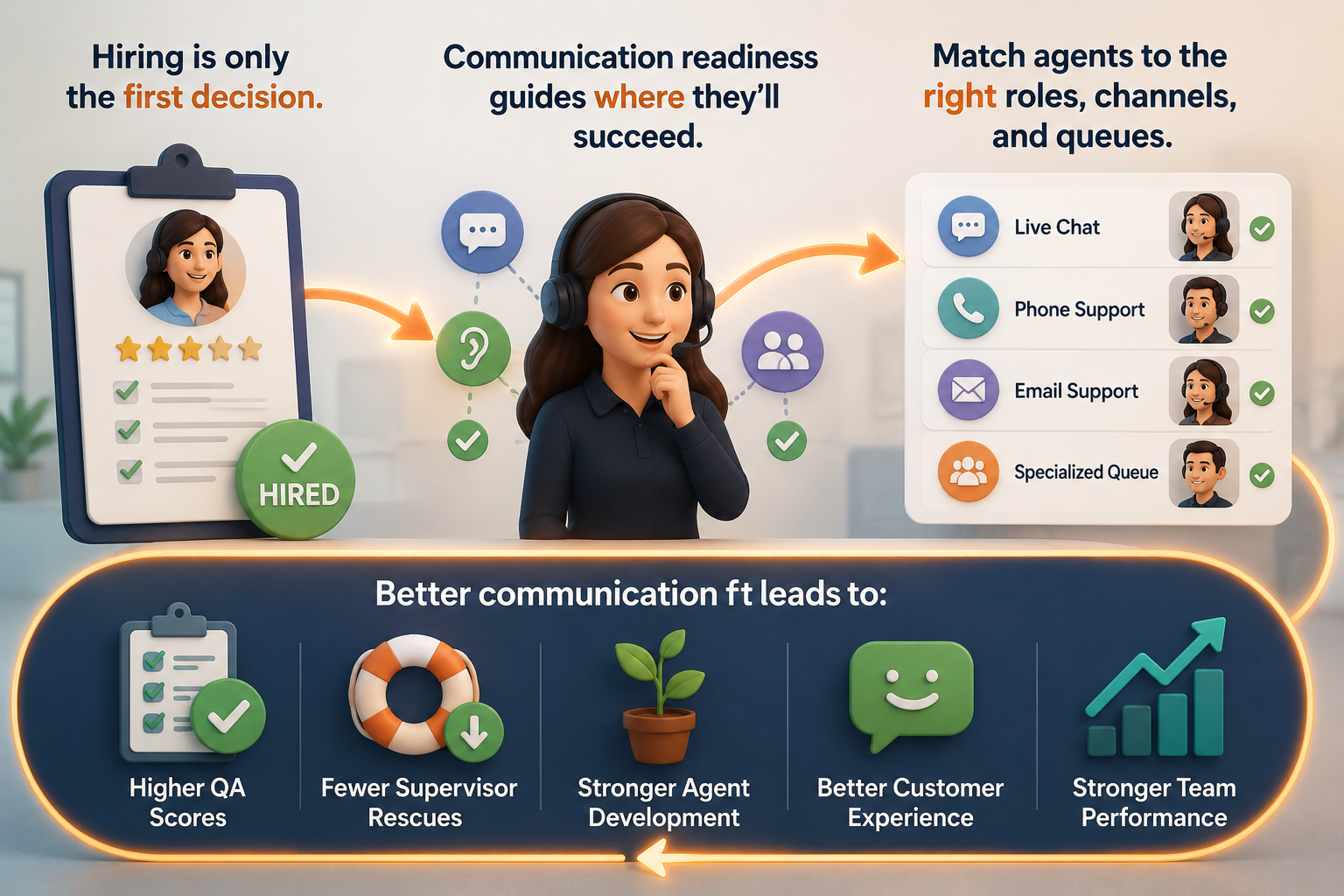
Contact center and BPO hiring processes are built around a simple decision. Do we hire this person or not? The question matters, but it is incomplete.
In real operations, the bigger question is often not only whether someone can do the work. It is whether they are being placed into the right kind of work.
A candidate may not be ready for a complex voice queue, but they may be strong in written support. An agent may struggle with escalations, but perform well in structured back-office communication. Another may be excellent at calming frustrated customers, but weaker when writing detailed case notes. Someone else may be clear and accurate in email, but not yet confident enough for live phone interactions.
If we treat all customer-facing roles as if they require the same communication profile, we miss the opportunity to make better placement decisions. That is where communication readiness becomes more than a hiring tool, it becomes a workforce placement strategy.
The Problem With Treating Agents as Interchangeable
In many operations, agents are moved into roles based on availability, staffing needs, ramp timelines, client demand, or who happens to be in the next training class. That is understandable, because operations move fast, and workforce planning is rarely perfect. But when communication fit is ignored, the cost shows up quickly.
An agent who is not ready for a high-emotion voice queue may need constant supervisor support. An agent who struggles with written clarity may create confusion in chat, email, ticketing, or customer updates. An agent who cannot explain process steps clearly may drive repeat contacts. An agent who avoids clarifying questions may make wrong assumptions and send work to the wrong place.
The person may not be a bad hire. They may be in the wrong seat. The distinction matters because the wrong seat can make a capable person look like a poor performer.
Communication Demands Change by Role
Not every customer role requires the same communication strengths.
A voice role often requires live listening, tone control, empathy, pace, and the ability to respond without much time to prepare
A chat role may require speed, written clarity, multitasking, and the ability to sound human in short written exchanges
An email or ticketing role may require structure, accuracy, documentation, and professional written tone
An escalation role requires emotional control, judgment, ownership language, and the ability to reduce customer effort
A technical support role may require step-by-step explanation, questioning, patience, and the ability to simplify complex information
A sales or retention role may require persuasion, confidence, listening, and the ability to explain value without sounding scripted
These are different communication environments. A single language score or interview impression may not tell you enough about where someone will perform best
Placement Should Not Be a Guess
Many teams already know this instinctively. Team leaders can often tell that one agent is stronger on voice while another is better in chat. Trainers notice who can explain clearly and who struggles to summarize. QA teams see patterns in tone, structure, next-step clarity, and written accuracy. The issue is that this knowledge often appears after placement has already happened.
By then, the agent may be struggling, the customer experience may already be affected, and the team leader may already be spending time coaching around problems that could have been anticipated earlier. Better placement means using communication evidence before the problem becomes operational.
That does not mean every decision will be perfect. It means the business should use better signals when deciding where people are most likely to succeed.
From Pass/Fail to Best Fit
A communication readiness approach changes the placement conversation.
Instead of asking only:
“Did this person pass?”
The better questions are:
“What kind of communication work is this person ready for?”
“Which channel fits their current strengths?”
“Where are the risks likely to show up?”
“What support would help them move into more complex work?”
This is especially important in high-volume hiring environments. When organizations are trying to fill classes quickly, it is tempting to use one standard for everyone. But a pass/fail model can leave value on the table.
Some candidates may not be ready for one role, but could succeed in another. Some agents may be placed into simpler queues first and developed toward more complex work. Some may be strong enough for customer-facing work, but need a channel that fits their current communication profile. That is not lowering the standard. It is making the standard more intelligent.
What Communication-Based Placement Looks Like
Communication-based placement uses evidence from assessments, interviews, QA, training, or performance observations to match people to the communication demands of the work.
For example:
An agent with strong listening and verbal empathy may be a good fit for voice support, complaints, or customer recovery work.
An agent with strong written clarity and structure may be a good fit for chat, email, documentation, or case management.
An agent who is accurate but less comfortable in live conversation may be better suited to back-office support while they build confidence.
An agent who explains processes clearly may be valuable in technical support, onboarding, internal helpdesk, or customer education.
An agent who struggles to manage frustration may not be ready for escalations, even if their English level is technically strong.
This is the kind of decision-making that turns communication data into operational value.
The Role of CEFR and Language Scores
CEFR and language proficiency scores can still be useful. They help create a common reference point for language ability, but they should not be the whole placement decision.
A B2 speaker may still struggle to calm an angry customer. A C1 speaker may write long, confusing updates. A B1 speaker may be highly effective in a structured role with clear templates and strong process support. A candidate with an accent may still be clear, organized, empathetic, and customer-ready.
The workplace question is not only, “What is this person’s English level?” The more useful question is:
“What communication demands can this person handle right now, and where can they grow next?”
Why This Matters for Operations
Better placement can improve more than individual performance. It can reduce early attrition, because agents are less likely to feel overwhelmed in roles they are not ready for. It can reduce supervisor rescue, because team leaders are not constantly compensating for poor fit. It can improve QA outcomes, because communication risks are better matched to role complexity. It can improve customer experience, because customers are more likely to reach someone who can handle the interaction well.
It can also make development more practical. Instead of telling an agent they are not good enough, the organization can say:
“You are ready for this type of work now, and here is what we need to build before moving you into the next level.”
That is a better conversation. It is more fair to the agent, more useful for the manager, and more valuable for the business.
Where Evala Fits
Evala helps teams understand communication readiness in a more practical way. It can give hiring, training, and operations leaders better insight into how people communicate, not just whether they meet a general language threshold.
That matters for placement. When teams understand where someone is strong and where they may need support, they can make better decisions about role fit, channel fit, queue assignment, training needs, and future development.
The goal is not to label people permanently. The goal is to place people intelligently, support them properly, and give them a better path to succeed. Because in customer operations, the right person in the wrong seat can still fail. And the right person in the right seat can become a high performer much faster.
Key Takeaways
Hiring is not the only decision that matters.
Communication readiness should help teams decide where a person is most likely to succeed, not only whether they should be hired.
Different channels require different communication strengths.
Voice, chat, email, back-office, technical support, and escalations each place different demands on the agent.
Poor fit can make good people look like poor performers.
An agent may struggle because they are in the wrong communication environment, not because they lack potential.
Language scores are useful but incomplete.
CEFR and English proficiency can help, but they do not always show role fit, channel readiness, empathy, structure, or next-step control.
Better placement creates operational value.
When people are matched to the right communication demands, organizations can improve QA, reduce supervisor rescue, support development, and improve customer experience.
Evala helps teams make smarter placement decisions.
By showing how people communicate in practical workplace situations, Evala helps leaders move from pass/fail hiring to better-fit workforce decisions.